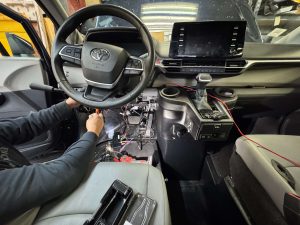
If you’ve been told by a doctor or driver rehabilitation specialist that hand controls could restore your ability to drive — or if you’ve been researching adaptive equipment on your own — you’re in the right place.
Hand controls are one of the most life-changing modifications available for drivers with lower-body disabilities. They allow you to operate your vehicle’s gas and brake entirely with your hands, putting independence back where it belongs: with you.
At AMS Auto in Woodstock, IL, we’ve been installing hand controls and adaptive driving equipment since 2008. Here’s what you should know before getting started.
Why Hand Controls Matter
For people living with spinal cord injuries, multiple sclerosis, cerebral palsy, limb loss, or other conditions affecting leg function, hand controls aren’t a workaround, they’re freedom. Being able to drive yourself to work, to a medical appointment, or just to the grocery store is something most people take for granted. Adaptive driving equipment gives that back.
Most hand controls are designed to work alongside your vehicle’s existing foot pedals, meaning the car can still be driven the conventional way by other household members. You’re not converting your car into something unusable for everyone else, you’re adding a layer of accessibility to it.
Mechanical vs. Electronic Hand Controls: What’s the Difference?
This is one of the most common questions we get, and the honest answer is: it depends on your needs, your vehicle, and your rehabilitation specialist’s recommendation.
Mechanical Hand Controls
Mechanical hand controls use a direct physical connection to your brake and accelerator. Common styles include:
- Push/Pull — pull toward you to accelerate, push away to brake. The most widely prescribed style.
- Push/Rock — a rocking motion that reduces fatigue and works well for drivers with limited finger dexterity. The handle can be installed on either side of the steering wheel.
- Push/Right Angle — the handle pivots downward to accelerate, reducing knee contact. Often called the “universal method” because it works for most disability types.
- Push/Rotate — a twist-and-push action similar to a motorcycle throttle. A good option for vehicles with limited space, as the device fits snugly next to the steering wheel.
Mechanical controls are reliable, straightforward, and often more affordable. Most require no permanent modifications to your vehicle.
Electronic Hand Controls
Electronic hand controls tap into your vehicle’s existing electronic signals rather than using a mechanical linkage. The result is a cleaner installation with more legroom, smoother acceleration response, and features like city-mode sensitivity adjustment. They tend to be the right choice for drivers who need more precision or have limited upper-body strength.
For a deeper look at the different styles available, see our guide: The Different Types of Electronic Hand Controls for Cars.
How Are Hand Controls Mounted?
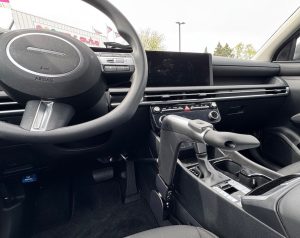
Hand controls also vary by where they attach to your vehicle. The most common is steering column-mounted — installed with no permanent modifications needed and very accessible to use. Floor-mounted controls (installed to the right of the driver’s seat, similar to a gearshift) are another option, and ring-style controls mount over or under the steering wheel and are operated with thumbs or fingers. Your rehabilitation specialist’s prescription will indicate which mounting style suits your situation.
What the Installation Process Looks Like in Illinois
Getting hand controls installed in Illinois isn’t complicated, but there are a few steps:
- CDRS evaluation (if you’re a new user) — Illinois requires that first-time adaptive equipment users complete training with a Certified Driver Rehabilitation Specialist, who evaluates your needs and writes a formal equipment prescription.
- Free consultation with AMS Auto — We’ll review your needs, your vehicle, and your prescription to recommend the right system and provide a clear written quote. No pressure, no hidden fees.
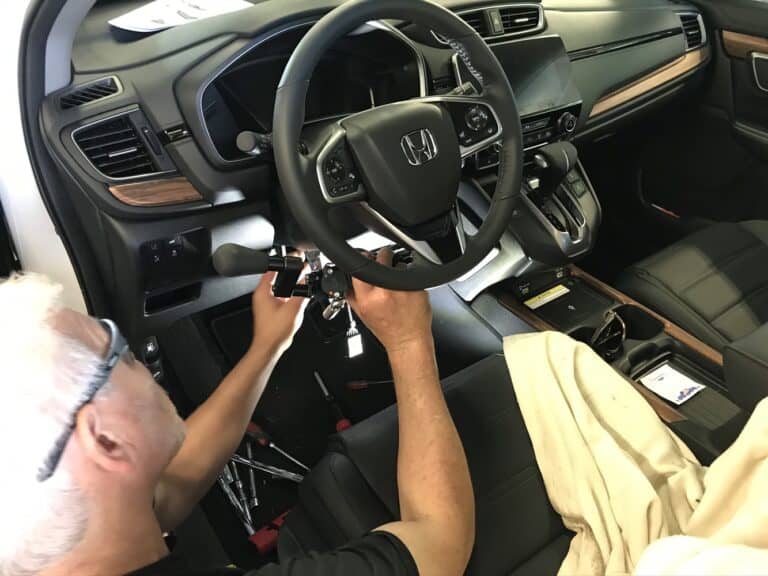
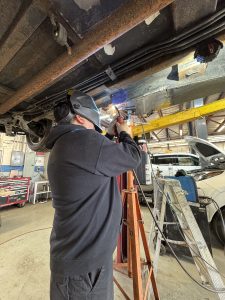
- Professional installation — Our certified technicians install and test your equipment, ensuring it’s properly fitted and adjusted for your comfort and safety.
- DMV endorsement — After installation, new users are required to test at their local Illinois DMV to have the adaptive restriction listed on their driver’s license.
The whole process is manageable — and you don’t have to navigate it alone.
Do Hand Controls Work on Any Vehicle?
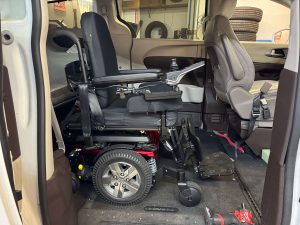
Not every control style is compatible with every vehicle, which is why working with a knowledgeable installer matters. Hand controls can only be installed in vehicles with automatic transmission, power steering, and power brakes. We work on cars, trucks, SUVs, and wheelchair accessible vans. If you’re also considering a lift or full conversion, we can address both in a single consultation.
If your current vehicle isn’t a good fit for the equipment you need, we have wheelchair accessible vehicles for sale — and we can outfit them with whatever adaptive driving equipment the new driver requires.
Can I Use HSA/FSA Funds or Get Financial Assistance?
Adaptive driving equipment may qualify as a medical expense, and some manufacturer rebate programs and non-profit grants are available to help offset costs. Our team is happy to walk you through what options may apply to your situation during your free consultation.
Ready to Drive Again? Start Here.
AMS Auto serves drivers across McHenry County, the greater Woodstock area, and throughout Chicagoland. We’re a family-owned business — not a mega-dealer — and we work personally with every customer to make sure the solution fits your life, not just your vehicle.
Call us at 815-527-7297, email [email protected], or contact us online to schedule your free consultation.